
<!-- LOEB:EN -->
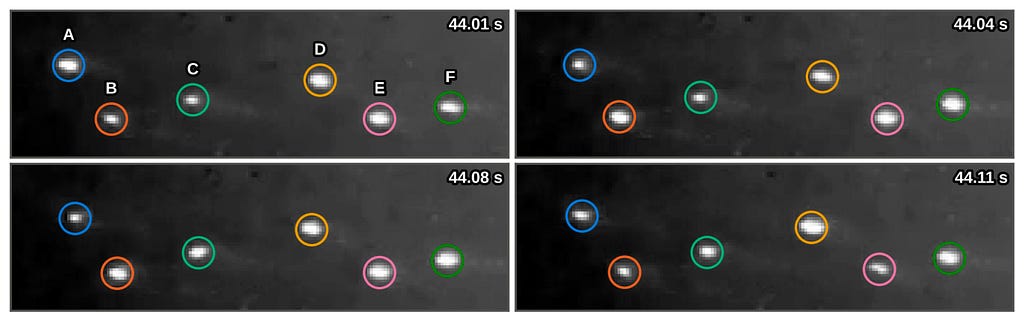
One of the most intriguing Unidentified Anomalous Phenomena (UAP) released by the Presidential Unsealing and Reporting System for UAP Encounters (PURSUE) on September 18, 2026, includes six dots in an infrared video recorded from a military aircraft over the Qaruh Island near Kuwait, labeled DOW-UAP-PR135. The mission report describes a group of six small objects moving at an estimated speed of 480 miles per hour.
The nature of these six dots has just been identified in a new paper, accessible here, co-authored by members of the UAP Science Advisory Council with Dr. Jacob Haqq-Misra as the lead author.
Over the past five months, the U.S. Department of War released six tranches of UAP records under its PURSUE program, including dozens of videos from infrared cameras on military aircraft. Redactions to the on-screen displays restrict the information in these released videos, making it difficult to infer the nature of the UAP. None of the sensor videos released under PURSUE provide the distance from the sensor to the UAP, leaving the UAP velocity uncertain. Without knowing the range, the motion of a small object near the aircraft, such as a bug, a bird or a balloon, can appear similarly to a faster larger object farther away. For example, in the “Go Fast” video recorded by the U.S. Navy in 2015, an object that appeared to skim the sea at high speed was actually far above the sea and moving at about the speed of the wind. However, the data that were available to resolve the “Go Fast” case are redacted in PURSUE videos.
The intriguing video DOW-UAP-PR135 was released together with a mission report DOW-UAP-D108, filed by a U.S. Air Force crew for a sighting on 29 July, 2025. The report describes six small objects grouped together, that “seemed to be agile, frequently changing direction” and were “able to change directions quickly and simultaneously.” The report lists the estimated velocity of 480 miles per hour, equivalent to 63% of the speed of sound (or 215 meters per second), at an estimated altitude of 6.7 kilometers.
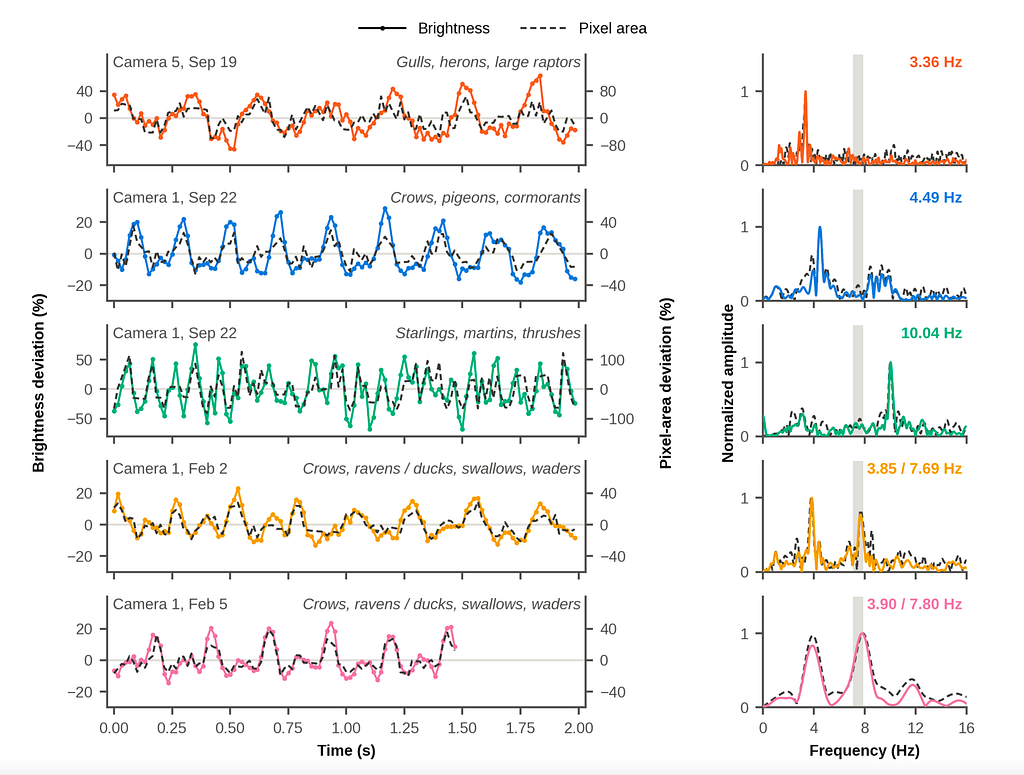
Birds can be recognized by their wingbeat. A flapping wing changes the projected surface area of the bird facing the camera, which modulates the bird’s infrared brightness at the wingbeat frequency or at twice that frequency. For birds in cruising flight, wingbeat frequencies range from about 2.5 beats per second for the largest birds to more than 10 beats per second for small songbirds. The frequency of such a beat does not depend on the distance, so it can be measured even when the distance is unknown.
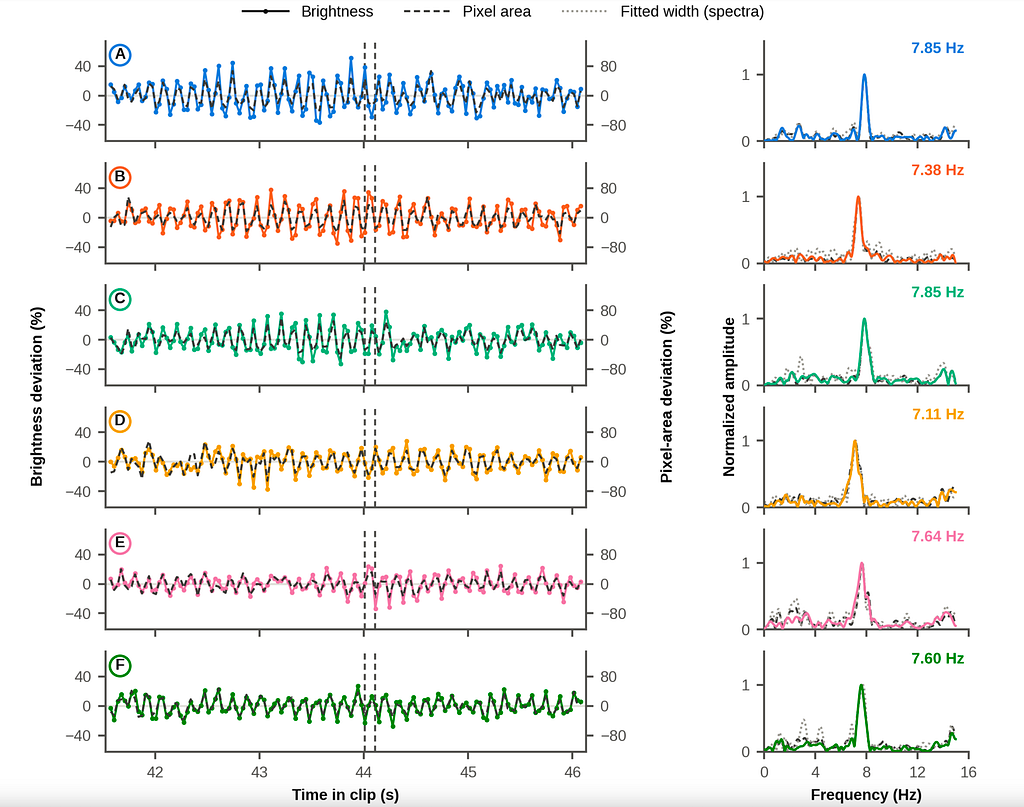
The DOW-UAP-PR135 video shows six compact warm dots that cross the field of view together. It would have been challenging to explain these dots as coordinated drones moving at 480 miles per hour because the limited communication rate of drones would risk collisions among them. The eyes and natural brains of birds operate at a higher rate, making their coordinated motion feasible. The infrared dots move relative to one another by tens of pixels within a couple of seconds, so that the group appears in turn as a line, a clump, pairs, and a loose ring. Each object brightens and dims repeatedly. The brightness of the objects beats in the narrow range of 7.11–7.85 beats per second, with amplitudes of 12–26% about the mean, and each beat stands 100–280 times above the median level of the background power spectrum of temporal fluctuations. In addition to brightness, the same beat also appears when measuring each object size in pixel area as well as its fitted Gaussian width. For every object, these three peak frequencies agree to within 0.13 beats per second.
The six objects do not beat together, and their frequencies span a range of 0.74 beats per second. The objects labeled A and C beat 7.85 times per second, E and F show 7.60–7.64 beats per second, B shows 7.38 beats per second and D exhibits 7.11 beats per second. Over the same frames, the phases between any two objects are out of oscillation phase between 30 and 170 degrees in magnitude, with 8 pairs more than 90 degrees apart. Even A and C, which show the same beat frequency, are 119 degrees apart. This eliminates video flicker as an explanation, as a beat produced by the video itself would reach all six objects at one frequency and in one phase.
The DOW-UAP-D108 report mentions a speed estimate without a distance measurement.
The reported speed of the UAP is what a slow flock of birds at 60–80% of the recording aircraft’s height would produce when no range is measured. The birds are nearer to the aircraft than the ground point on which the speed was estimated. The number of objects, their changing arrangement, and the report’s description of objects that were agile and changed direction, are all consistent with this interpretation.
The flicker frequencies of the six objects lie within the range measured for birds in cruising flight. Birds are known beat their wings faster in thinner air. Among nocturnal migrants tracked by radar, the wingbeat frequency rose by 0.4 hertz (beats per second) per kilometer of altitude in flap-gliding birds and by 1.1 hertz per kilometer in bounding birds. This suggests that birds at the inferred altitude of up to 3 kilometers could beat about 3 hertz faster than the same birds near sea level. The frequency alone does not constrain a species. Six birds flying together would be expected to beat at similar but not identical rates and out of phase, as observed in DOW-UAP-PR135.
The limits of the above analysis are posed by the absence of sufficient data, in particular the altitude of the camera. Conclusive results require access to aircraft location, sensor telemetry and unredacted video, so that inferences can be vetted rather than left to ambiguous interpretation.
The specific location of the video footage is Qaruh Island near Kuwait, identified in a Google Map here. When the DOW-UAP-PR135 infrared video was taken in July 29, 2025, the skies and waters surrounding Qaruh Island were predominantly occupied by breeding seabirds, specifically four core species of terns and visiting Socotra cormorants. Late July represents the peak summer breeding and nesting season for these specialized marine birds on Kuwait’s southern subtropical coral cays.
UAP are a mixed bag, with most objects being natural or human made. But even if one in a million UAP represents a non-human technological origin, this one object would constitute the biggest discovery ever made by humanity. Such a discovery can only rest on the solid foundation of exquisite scientific data, not on the fleeting opinions expressed on social media.
Professional website:
https://lweb.cfa.harvard.edu/~loeb/
https://avi-loeb.medium.com/https://www ... sorAviLoeb
https://open.spotify.com/show/1zhndXkvS ... rofAviLoeb
<!-- LOEB:CN -->
2026年9月18日,总统开启和报告UAP遭遇系统( SEARCH )发布了最有趣的不明异常现象( UAP )之一,其中包括科威特附近卡鲁岛上空一架军用飞机拍摄的红外视频中的六个点,标记为DOW-UAP-PR135。任务报告描述了一组六个小物体以48的估计速度移动0英里/小时。
这六个点的性质刚刚在一篇新论文中确定,可在此处访问,该论文由UAP科学咨询委员会成员共同撰写, Jacob Haqq-Misra博士为主要作者。
在过去的五个月里,美国陆军部在其追踪计划下发布了六批UAP记录,其中包括来自军用飞机红外摄像头的数十个视频。屏幕显示的编辑限制了这些发布视频中的信息,因此很难推断UAP的性质。在追踪下发布的任何传感器视频都不能提供从传感器到UAP的距离,从而使UAP速度不确定。在不知道距离的情况下,飞行器附近的小物体(如虫子、鸟或气球)的运动可能会类似到更远处更快的较大物体。 例如,在美国海军2015年录制的“Go Fast”视频中,一个似乎高速掠过海面的物体实际上远离海面,并以风速左右的速度移动。 但是,在追踪视频中会编辑可用于解决“快速处理”个案的数据。
有趣的视频DOW-UAP-PR135一起发布由美国空军机组人员于2025年7月29日提交的任务报告DOW-UAP-D108。该报告描述了六个小对象组合在一起, “看起来很敏捷,经常改变方向” ,并且“能够快速、同时地改变方向”。该报告列出的估计速度为每小时480英里,相当于声速的63 % (或215米r秒) ,估计海拔6.7公里。
鸟类可以通过它们的翅膀来识别。 拍打的翅膀改变了鸟类面向相机的投影表面积,这在翅膀拍打频率或该频率的两倍下调节鸟类的红外亮度。 对于巡航飞行中的鸟类,翅膀跳动的频率范围从最大的鸟类每秒约2.5次到更多小型鸣禽的鸣叫频率低于每秒10次。这种鸣叫频率与距离无关,因此即使距离未知也能测量。
DOW-UAP-PR135视频显示六个紧凑的暖色光点同时穿过视野。由于通信速率有限,很难将这些光点解释为以每小时480英里速度协同移动的无人机。无人机之间发生碰撞的风险。鸟类的眼睛和自然大脑以更高的速度运作,使它们的协调运动成为可能。红外光点在几秒钟内相对于彼此移动数十个像素,因此该组依次显示为一条线、一个团块、一对和松散的环。每个对象都会反复变亮和变暗。物体的亮度跳动频率范围在每秒 7.11 至 7.85 次之间,振幅约为平均值的 12% 至 26%,每个节拍的频率比背景时间波动功率谱的中值高出 100 至 280 倍。除了亮度之外,在测量每个物体的像素面积及其拟合高斯宽度时,也会出现相同的节拍。对于每个物体,这三个峰值频率一致。误差在每秒 0.13 次以内。
这六个物体的拍频并不同步,它们的拍频范围为每秒0.74次。标记为A和C的物体拍频为每秒7.85次,E和F的拍频为每秒7.60至7.64次,B的拍频为每秒7.38次,D的拍频为每秒7.11次。在同一帧中,任意两个物体之间的相位差在30°至30°之间。幅度为 170 度,其中 8 对点之间的角度差超过 90 度。即使是频率相同的 A 和 C,角度差也达到了 119 度。这排除了视频闪烁的可能性,因为视频本身产生的拍频信号会以相同的频率和相位到达所有六个物体。
DOW-UAP-D108 报告提到了速度估算,但没有距离测量。
据报道,该速度为e UAP是当没有测量范围时,在记录飞机高度的60-80 %处缓慢的鸟群会产生的结果。 鸟类比估计速度的地面点更接近飞机。 对象的数量、它们的变化排列以及报告对敏捷和改变方向的对象的描述都与这种解释相一致。
电影这六个物体的振动频率均在鸟类巡航飞行时所测得的频率范围内。众所周知,鸟类在稀薄的空气中振翅速度更快。在雷达追踪的夜间迁徙鸟类中,滑翔鸟类的振翅频率每升高1公里增加0.4赫兹(每秒振翅次数),而跳跃鸟类的振翅频率每升高1公里增加1.1赫兹。这表明,在推断的高度范围内,鸟类的振翅频率可能更高。可以比海平面附近的同一只鸟更快地击败大约3赫兹。 频率本身并不限制一个物种。 正如DOW-UAP-PR135中观察到的那样,六只一起飞行的鸟预计会以相似但不相同的速度跳动并且异相。
上述分析的局限性是由于缺乏足够的数据,特别是相机的海拔高度。聚类结果需要访问飞机位置、传感器遥测和未经编辑的视频,因此可以对推论进行审查,而不是任由模棱两可的解释。
视频录像的具体位置是科威特附近的卡鲁岛( Qaruh Island ) ,可在此处的谷歌地图中找到。 当2025年7月29日拍摄DOW-UAP-PR135红外视频时, Qaruh岛周围的天空和水域这里是海鸟繁殖的热门地点,特别是四种主要的燕鸥以及来自索科特拉岛的鸬鹚。七月下旬是这些特有海鸟在科威特南部亚热带珊瑚礁进行夏季繁殖和筑巢的高峰期。
UAP(不明空中现象)成分复杂,大多数物体是天然的或人造的。但即使百万分之一的UAP代表着非人类的技术起源,这一个物体将构成人类有史以来最大的发现。 这样的发现只能建立在精湛的科学数据的坚实基础之上,而不是建立在社交媒体上短暂表达的意见之上。
专业网站:
https://lweb.cfa.harvard.edu/~loeb/
https://avi-loeb.medium.com/https://www.youtube.com/ @ ProfessorAviLoeb
https://open.spotify.com/show/1zhndXkvS ... rofAviLoeb
<!-- LOEB:END -->
---
原文链接:https://avi-loeb.medium.com/the-six-inf ... 0a38f33ca7
作者:Avi Loeb(哈佛大学天文系教授)
One of the most intriguing Unidentified Anomalous Phenomena (UAP) released by the Presidential Unsealing and Reporting System for UAP Encounters (PURSUE) on September 18, 2026, includes six dots in an infrared video recorded from a military aircraft over the Qaruh Island near Kuwait, labeled DOW-UAP-PR135. The mission report describes a group of six small objects moving at an estimated speed of 480 miles per hour.
The nature of these six dots has just been identified in a new paper, accessible here, co-authored by members of the UAP Science Advisory Council with Dr. Jacob Haqq-Misra as the lead author.
Over the past five months, the U.S. Department of War released six tranches of UAP records under its PURSUE program, including dozens of videos from infrared cameras on military aircraft. Redactions to the on-screen displays restrict the information in these released videos, making it difficult to infer the nature of the UAP. None of the sensor videos released under PURSUE provide the distance from the sensor to the UAP, leaving the UAP velocity uncertain. Without knowing the range, the motion of a small object near the aircraft, such as a bug, a bird or a balloon, can appear similarly to a faster larger object farther away. For example, in the “Go Fast” video recorded by the U.S. Navy in 2015, an object that appeared to skim the sea at high speed was actually far above the sea and moving at about the speed of the wind. However, the data that were available to resolve the “Go Fast” case are redacted in PURSUE videos.
The intriguing video DOW-UAP-PR135 was released together with a mission report DOW-UAP-D108, filed by a U.S. Air Force crew for a sighting on 29 July, 2025. The report describes six small objects grouped together, that “seemed to be agile, frequently changing direction” and were “able to change directions quickly and simultaneously.” The report lists the estimated velocity of 480 miles per hour, equivalent to 63% of the speed of sound (or 215 meters per second), at an estimated altitude of 6.7 kilometers.
Birds can be recognized by their wingbeat. A flapping wing changes the projected surface area of the bird facing the camera, which modulates the bird’s infrared brightness at the wingbeat frequency or at twice that frequency. For birds in cruising flight, wingbeat frequencies range from about 2.5 beats per second for the largest birds to more than 10 beats per second for small songbirds. The frequency of such a beat does not depend on the distance, so it can be measured even when the distance is unknown.
The DOW-UAP-PR135 video shows six compact warm dots that cross the field of view together. It would have been challenging to explain these dots as coordinated drones moving at 480 miles per hour because the limited communication rate of drones would risk collisions among them. The eyes and natural brains of birds operate at a higher rate, making their coordinated motion feasible. The infrared dots move relative to one another by tens of pixels within a couple of seconds, so that the group appears in turn as a line, a clump, pairs, and a loose ring. Each object brightens and dims repeatedly. The brightness of the objects beats in the narrow range of 7.11–7.85 beats per second, with amplitudes of 12–26% about the mean, and each beat stands 100–280 times above the median level of the background power spectrum of temporal fluctuations. In addition to brightness, the same beat also appears when measuring each object size in pixel area as well as its fitted Gaussian width. For every object, these three peak frequencies agree to within 0.13 beats per second.
The six objects do not beat together, and their frequencies span a range of 0.74 beats per second. The objects labeled A and C beat 7.85 times per second, E and F show 7.60–7.64 beats per second, B shows 7.38 beats per second and D exhibits 7.11 beats per second. Over the same frames, the phases between any two objects are out of oscillation phase between 30 and 170 degrees in magnitude, with 8 pairs more than 90 degrees apart. Even A and C, which show the same beat frequency, are 119 degrees apart. This eliminates video flicker as an explanation, as a beat produced by the video itself would reach all six objects at one frequency and in one phase.
The DOW-UAP-D108 report mentions a speed estimate without a distance measurement.
The reported speed of the UAP is what a slow flock of birds at 60–80% of the recording aircraft’s height would produce when no range is measured. The birds are nearer to the aircraft than the ground point on which the speed was estimated. The number of objects, their changing arrangement, and the report’s description of objects that were agile and changed direction, are all consistent with this interpretation.
The flicker frequencies of the six objects lie within the range measured for birds in cruising flight. Birds are known beat their wings faster in thinner air. Among nocturnal migrants tracked by radar, the wingbeat frequency rose by 0.4 hertz (beats per second) per kilometer of altitude in flap-gliding birds and by 1.1 hertz per kilometer in bounding birds. This suggests that birds at the inferred altitude of up to 3 kilometers could beat about 3 hertz faster than the same birds near sea level. The frequency alone does not constrain a species. Six birds flying together would be expected to beat at similar but not identical rates and out of phase, as observed in DOW-UAP-PR135.
The limits of the above analysis are posed by the absence of sufficient data, in particular the altitude of the camera. Conclusive results require access to aircraft location, sensor telemetry and unredacted video, so that inferences can be vetted rather than left to ambiguous interpretation.
The specific location of the video footage is Qaruh Island near Kuwait, identified in a Google Map here. When the DOW-UAP-PR135 infrared video was taken in July 29, 2025, the skies and waters surrounding Qaruh Island were predominantly occupied by breeding seabirds, specifically four core species of terns and visiting Socotra cormorants. Late July represents the peak summer breeding and nesting season for these specialized marine birds on Kuwait’s southern subtropical coral cays.
UAP are a mixed bag, with most objects being natural or human made. But even if one in a million UAP represents a non-human technological origin, this one object would constitute the biggest discovery ever made by humanity. Such a discovery can only rest on the solid foundation of exquisite scientific data, not on the fleeting opinions expressed on social media.
Professional website:
https://lweb.cfa.harvard.edu/~loeb/
https://avi-loeb.medium.com/https://www ... sorAviLoeb
https://open.spotify.com/show/1zhndXkvS ... rofAviLoeb
<!-- LOEB:CN -->
2026年9月18日,总统开启和报告UAP遭遇系统( SEARCH )发布了最有趣的不明异常现象( UAP )之一,其中包括科威特附近卡鲁岛上空一架军用飞机拍摄的红外视频中的六个点,标记为DOW-UAP-PR135。任务报告描述了一组六个小物体以48的估计速度移动0英里/小时。
这六个点的性质刚刚在一篇新论文中确定,可在此处访问,该论文由UAP科学咨询委员会成员共同撰写, Jacob Haqq-Misra博士为主要作者。
在过去的五个月里,美国陆军部在其追踪计划下发布了六批UAP记录,其中包括来自军用飞机红外摄像头的数十个视频。屏幕显示的编辑限制了这些发布视频中的信息,因此很难推断UAP的性质。在追踪下发布的任何传感器视频都不能提供从传感器到UAP的距离,从而使UAP速度不确定。在不知道距离的情况下,飞行器附近的小物体(如虫子、鸟或气球)的运动可能会类似到更远处更快的较大物体。 例如,在美国海军2015年录制的“Go Fast”视频中,一个似乎高速掠过海面的物体实际上远离海面,并以风速左右的速度移动。 但是,在追踪视频中会编辑可用于解决“快速处理”个案的数据。
有趣的视频DOW-UAP-PR135一起发布由美国空军机组人员于2025年7月29日提交的任务报告DOW-UAP-D108。该报告描述了六个小对象组合在一起, “看起来很敏捷,经常改变方向” ,并且“能够快速、同时地改变方向”。该报告列出的估计速度为每小时480英里,相当于声速的63 % (或215米r秒) ,估计海拔6.7公里。
鸟类可以通过它们的翅膀来识别。 拍打的翅膀改变了鸟类面向相机的投影表面积,这在翅膀拍打频率或该频率的两倍下调节鸟类的红外亮度。 对于巡航飞行中的鸟类,翅膀跳动的频率范围从最大的鸟类每秒约2.5次到更多小型鸣禽的鸣叫频率低于每秒10次。这种鸣叫频率与距离无关,因此即使距离未知也能测量。
DOW-UAP-PR135视频显示六个紧凑的暖色光点同时穿过视野。由于通信速率有限,很难将这些光点解释为以每小时480英里速度协同移动的无人机。无人机之间发生碰撞的风险。鸟类的眼睛和自然大脑以更高的速度运作,使它们的协调运动成为可能。红外光点在几秒钟内相对于彼此移动数十个像素,因此该组依次显示为一条线、一个团块、一对和松散的环。每个对象都会反复变亮和变暗。物体的亮度跳动频率范围在每秒 7.11 至 7.85 次之间,振幅约为平均值的 12% 至 26%,每个节拍的频率比背景时间波动功率谱的中值高出 100 至 280 倍。除了亮度之外,在测量每个物体的像素面积及其拟合高斯宽度时,也会出现相同的节拍。对于每个物体,这三个峰值频率一致。误差在每秒 0.13 次以内。
这六个物体的拍频并不同步,它们的拍频范围为每秒0.74次。标记为A和C的物体拍频为每秒7.85次,E和F的拍频为每秒7.60至7.64次,B的拍频为每秒7.38次,D的拍频为每秒7.11次。在同一帧中,任意两个物体之间的相位差在30°至30°之间。幅度为 170 度,其中 8 对点之间的角度差超过 90 度。即使是频率相同的 A 和 C,角度差也达到了 119 度。这排除了视频闪烁的可能性,因为视频本身产生的拍频信号会以相同的频率和相位到达所有六个物体。
DOW-UAP-D108 报告提到了速度估算,但没有距离测量。
据报道,该速度为e UAP是当没有测量范围时,在记录飞机高度的60-80 %处缓慢的鸟群会产生的结果。 鸟类比估计速度的地面点更接近飞机。 对象的数量、它们的变化排列以及报告对敏捷和改变方向的对象的描述都与这种解释相一致。
电影这六个物体的振动频率均在鸟类巡航飞行时所测得的频率范围内。众所周知,鸟类在稀薄的空气中振翅速度更快。在雷达追踪的夜间迁徙鸟类中,滑翔鸟类的振翅频率每升高1公里增加0.4赫兹(每秒振翅次数),而跳跃鸟类的振翅频率每升高1公里增加1.1赫兹。这表明,在推断的高度范围内,鸟类的振翅频率可能更高。可以比海平面附近的同一只鸟更快地击败大约3赫兹。 频率本身并不限制一个物种。 正如DOW-UAP-PR135中观察到的那样,六只一起飞行的鸟预计会以相似但不相同的速度跳动并且异相。
上述分析的局限性是由于缺乏足够的数据,特别是相机的海拔高度。聚类结果需要访问飞机位置、传感器遥测和未经编辑的视频,因此可以对推论进行审查,而不是任由模棱两可的解释。
视频录像的具体位置是科威特附近的卡鲁岛( Qaruh Island ) ,可在此处的谷歌地图中找到。 当2025年7月29日拍摄DOW-UAP-PR135红外视频时, Qaruh岛周围的天空和水域这里是海鸟繁殖的热门地点,特别是四种主要的燕鸥以及来自索科特拉岛的鸬鹚。七月下旬是这些特有海鸟在科威特南部亚热带珊瑚礁进行夏季繁殖和筑巢的高峰期。
UAP(不明空中现象)成分复杂,大多数物体是天然的或人造的。但即使百万分之一的UAP代表着非人类的技术起源,这一个物体将构成人类有史以来最大的发现。 这样的发现只能建立在精湛的科学数据的坚实基础之上,而不是建立在社交媒体上短暂表达的意见之上。
专业网站:
https://lweb.cfa.harvard.edu/~loeb/
https://avi-loeb.medium.com/https://www.youtube.com/ @ ProfessorAviLoeb
https://open.spotify.com/show/1zhndXkvS ... rofAviLoeb
<!-- LOEB:END -->
---
原文链接:https://avi-loeb.medium.com/the-six-inf ... 0a38f33ca7
作者:Avi Loeb(哈佛大学天文系教授)