
<!-- LOEB:EN -->


The Universe started with a nearly uniform density of matter and radiation. If the initial density fluctuations were a hundred times weaker, the Universe today would have been dark, filled with a nearly homogeneous gas of mostly hydrogen atoms at a density of one atom per 4 cubic meters and a temperature of 0.02 degrees K above absolute zero! Such a Universe involves nothing to write home about for three different reasons: there would have been no writer, no surface to write on, and nowhere to call home.
In the actual Universe we inhabit, the deviations from the mean density were initially one part in a hundred thousand. If they had been below a part in ten million, then no structure would have had enough time to condense gravitationally in the first 9 billion years of cosmic history. Subsequently, the accelerated cosmic expansion, triggered by dark energy, would have halted any further growth of structure. In that case, the Universe would have simply cooled through cosmic expansion. The hydrogen gas would have cooled faster than the cosmic microwave background — the relic radiation from the Big Bang with a current temperature of 2.726 degrees Kelvin. In the first 10 million years after the Big Bang, the gas and radiation were thermally coupled, but this coupling was later lost. By now, the hydrogen gas would have cooled to a temperature that is 150 times lower than the microwave background, namely 0.02 degrees Kelvin!
The entire Universe would have been filled with an extremely cold and rarefied hydrogen gas if it had started with density fluctuations that are a hundred times smaller. Throughout the entire observable volume, stretching out to 46.5 billion light years, there would have been no galaxies, no stars, no planets and no life. Just a nearly uniform fog of matter and radiation, fading away.
These conditions could have been summarized on a single sheet of paper.
Compare that to the actual information content of our Universe. In 2026, humanity invested more than half a trillion dollars in data centers for training artificial intelligence (AI) systems. These data centers store information from Earth. There are more than a hundred billion planets in the Milky-Way galaxy along and more than a trillion galaxies in the observable volume of the Universe. We would have needed to invest at least 10^{35} dollars to store information from all these planets, not to speak about additional information concerning their host stars or the fact that cosmic history spans a time period that is a million times longer than documented human history. All of this information would not have existed if the primordial density fluctuations were a hundred times smaller. In that case, the entire information content of the cosmos would have fit on a single sheet of paper.
The only reason we find a rich content in the present-day Universe, is thanks to the gravitational growth of the primordial fluctuations to galaxies, stars and planets.
In reality, the seed fluctuations had enough time to grow gravitationally. Regions which were slightly denser than average became denser over time. Owing to their self-gravity, and eventually collapsed to form gravitationally-bound objects like galaxies, inside of which gas fragmented into stars, leaving behind debris that coalesced into planets. The formation of the first stars and galaxies started about 100 million years after the Big Bang.
The first galaxies were roughly a million times less massive than the Milky-Way galaxy. Over time, they hierarchically merged like Lego-pieces to make bigger galaxies. Inside galaxies, gas condensed to a disk with a density that is about a million times higher than the cosmic average, then clumped into molecular clouds where the mean density rose by another 4 orders of magnitude and finally, it fragmented into stars where the density grew by another 20 orders of magnitude. The Solar System is an extremely dense region relative to a typical region of its volume in the Universe.
My career as faculty at Harvard University started three decades ago in forecasting how the first stars and galaxies formed in the early Universe. These stars illuminated the Universe and also heated and broken the hydrogen atoms through the process of reionization. This research frontier defines the scientific version of the story of genesis: “Let There Be Light!” Fifteen years ago, I wrote two textbooks on the subject, published here and here. By now, the related predictions were mostly verified by the latest data from the Webb telescope.
The fact that the Universe was not perfectly uniform accounts for our cosmic blessings, as our day is dominated by light from the Sun and our night sky is full of stars. Life would not have been possible in a perfectly uniform cosmos. For details about how life actually emerged in our cosmos, see my third textbook here.
The stars that light up our sky are nuclear fusion reactors, bound by gravity. They burn mostly hydrogen, left over from the Big Bang, and eventually consume their fuel. The Sun will die in 7.6 billion years. The lowest mass (dwarf) stars will last for 10 trillion years, about a thousand time longer. All in all, over trillions of years, these beautiful lights in the sky will all die. The fireworks that were lit up thanks to the primordial density fluctuations will eventually be extinguished like vigil candles for the life forms that ever blossomed in the cosmos.
Eventually, there will be nobody left to mourn what was lost. Darkness is the ultimate fate irrespective of the initial fluctuations. It was fun to join the party while it lasted. But in retrospect, stellar fireworks are just a temporary flicker of hope around the sobering truth that nothing survives death.
Understanding these circumstances teaches us modesty. Life in the cosmos is an afterthought. Even with the primordial density fluctuations, the first 100 million years after the Big Bang included no galaxies, no stars and no planets. The Sun was born in the last third of cosmic history, 4.6 billion years ago. The human species emerged only in the last 0.1% of cosmic history.
With this perspective, we should have never had the hubris to believe that we reside at the center of the Universe or that the Universe was created with us in mind. Moreover, given the huge number of Earth-Sun analogs, we are probably not unique or special, nor are we at the top of the cosmic food chain. And if aliens visit the inner Solar System, it is not because of us. In case they had been around long before us, they are the indigenous species of our cosmic neighborhood that merits respect, not us.
For the world religions, it is important to acknowledge that God is probably not a parent to a single child. Most of our siblings in the family of intelligent civilizations died by now. It is our duty to find the most accomplished ones and learn from them with humility and no sense of jealousy.
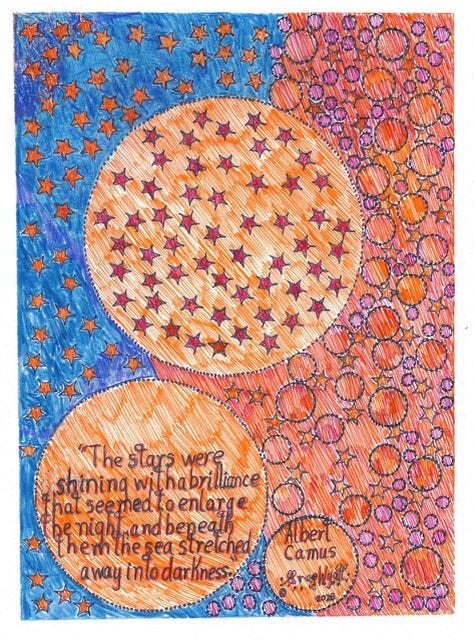
In this essay, I featured fourteen amazingly beautiful watercolors from a series created and sent to me by the celebrated artist, Greg Wyatt.
Professional website:
https://lweb.cfa.harvard.edu/~loeb/
https://avi-loeb.medium.com/https://www ... sorAviLoeb
https://open.spotify.com/show/1zhndXkvS ... rofAviLoeb
<!-- LOEB:CN -->
宇宙始于几乎均匀的物质和辐射密度。如果最初的密度波动弱一百倍,今天的宇宙就会是黑暗的,充满了几乎均匀的氢原子气体,密度为每4立方米一个原子,温度高于绝对零度0.02 K !这样一个宇宙不涉及任何关于fo的文章有三个不同的原因:没有作家,没有写作的表面,也没有称之为家的地方。
在我们居住的实际宇宙中,与平均密度的偏差最初是十万分之一。 如果它们低于千万分之一,那么在宇宙历史的前90亿年中,没有任何结构有足够的时间来凝结引力。随后,由暗能量引发的加速宇宙膨胀将阻止结构的任何进一步增长。在这种情况下,宇宙会通过宇宙膨胀简单地冷却。氢气的冷却速度会比宇宙微波背景更快--来自大爆炸的遗迹辐射,目前的温度为2.726开尔文。在最初的1000万年里在大爆炸之后,气体和辐射发生了热耦合,但这种耦合后来丢失了。 现在,氢气已经冷却到比微波背景低150倍的温度,即0.02开尔文!
如果宇宙一开始的密度波动是100 ,那么整个宇宙就会充满极冷和稀薄的氢气。在整个可观测的体积中,延伸到465亿光年,没有星系,没有恒星,没有行星,也没有生命。 只是一团几乎均匀的物质和辐射雾,逐渐消失。
这些条件可以总结在一张纸上。
将其与我们宇宙的实际信息内容进行比较。 2026年,人类投资了月超过五万亿美元的数据中心用于训练人工智能( AI )系统。这些数据中心存储来自地球的信息。银河系中有超过一千亿颗行星,可观测的宇宙体积中有超过一万亿个星系。我们需要投入至少10 ^ {35} 美元来存储所有这些星球的信息,更不用说有关其主星的其他信息,或者宇宙历史跨越的时间段比记录的人类历史长一百万倍的事实。如果原始密度波动小一百倍,所有这些信息都不会存在。在这种情况下,宇宙的全部信息内容都可以放在一张教皇纸上r.
我们在当今宇宙中发现丰富内容的唯一原因是由于星系、恒星和行星的原始波动的引力增长。
实际上,种子波动有足够的时间引力生长。 随着时间的推移,略高于平均水平的区域变得更加密集。 由于它们的自身引力,最终坍塌形成重力--像星系这样的束缚物体,其中的气体分裂成恒星,留下聚合成行星的碎片。 第一批恒星和星系的形成始于大爆炸后约1亿年。
第一批星系的质量大约是银河系的一百万倍。 随着时间的推移,它们像乐高碎片一样分层合并,形成更大的星系。轴,气体凝结成密度比宇宙平均值高约一百万倍的圆盘,然后聚集成分子云,平均密度再增加4个数量级,最后分裂成恒星,密度再增加20个数量级。相对于其体积在大学的典型区域,太阳系是一个非常密集的区域erse.
我作为哈佛大学教师的职业生涯始于三十年前预测早期宇宙中第一批恒星和星系是如何形成的。 这些恒星照亮了宇宙,并通过再电离过程加热并破坏了氢原子。 这个研究前沿定义了创世纪故事的科学版本: “让光明降临!” 十五年前,我e在这里和这里出版的关于该主题的两本教科书。 到目前为止,相关的预测大多由韦伯望远镜的最新数据来验证。
宇宙不是完全一致的事实说明了我们的宇宙祝福,因为我们的一天是由来自太阳的光线主导的,而我们的夜空充满了星星。 在一个完全均匀的宇宙中,生活是不可能的。关于生命是如何在我们的宇宙中出现的,请参阅我的第三本教科书。
照亮我们天空的恒星是受重力束缚的核聚变反应堆。 它们主要燃烧大爆炸遗留下来的氢气,最终消耗它们的燃料。 太阳将在76亿年后死亡。 最低质量的恒星(矮星)将持续10万亿年,大约长一千倍。 总而言之,超过三次亿万年后,这些天空中美丽的星光终将消逝。这些因远古密度波动而点亮的绚丽烟火,最终将如同守夜的蜡烛,为曾经在宇宙中绽放的生命而熄灭。
最终,将无人会为失去的一切而哀悼。无论最初的波动如何,黑暗才是最终的归宿。参与其中真是一件乐事。派对持续时间。 但回想起来,恒星烟花只是一个暂时的希望闪烁,围绕着一个发人深省的事实,那就是没有什么能在死亡中幸存下来。
了解这些情况会教会我们谦虚。 宇宙中的生活是事后的想法。 即使在原始密度波动的情况下,大爆炸后的前1亿年也没有星系,没有恒星,也没有行星。太阳诞生于宇宙历史的最后三分之一, 46亿年前。 人类物种仅在宇宙历史的最后0.1%中出现。
从这个角度来看,我们永远不应该傲慢地相信我们居住在宇宙的中心,或者宇宙是与我们一起创造的。 此外,鉴于地球-太阳类似物的数量庞大,我们可能不是独一无二的或特殊的,我们是否处于宇宙食物链的顶端。 如果外星人访问太阳系内部,那不是因为我们。 以防它们在我们之前很久就已经存在了,它们是我们宇宙邻里的本土物种,值得尊重,而不是我们。
对于世界宗教来说,重要的是要承认上帝可能不是一个孩子的父母。 我们大多数intelli家族的兄弟姐妹绅士文明现在已经死亡。 我们有责任找到最有成就的人,并以谦卑和没有嫉妒的态度向他们学习。
在这篇文章中,我展示了由著名艺术家格雷格·怀亚特( Greg Wyatt )创作并发送给我的14幅令人惊叹的美丽水彩画。
专业网站:
https://lweb.cfa.harvard.edu/~loeb/
https://avi-loeb.medium.com/https://www.youtube.com/ @ ProfessorAviLoeb
https://open.spotify.com/show/1zhndXkvS ... rofAviLoeb
<!-- LOEB:END -->
---
原文链接:https://avi-loeb.medium.com/watching-th ... dfb4c7590e
作者:Avi Loeb(哈佛大学天文系教授)
The Universe started with a nearly uniform density of matter and radiation. If the initial density fluctuations were a hundred times weaker, the Universe today would have been dark, filled with a nearly homogeneous gas of mostly hydrogen atoms at a density of one atom per 4 cubic meters and a temperature of 0.02 degrees K above absolute zero! Such a Universe involves nothing to write home about for three different reasons: there would have been no writer, no surface to write on, and nowhere to call home.
In the actual Universe we inhabit, the deviations from the mean density were initially one part in a hundred thousand. If they had been below a part in ten million, then no structure would have had enough time to condense gravitationally in the first 9 billion years of cosmic history. Subsequently, the accelerated cosmic expansion, triggered by dark energy, would have halted any further growth of structure. In that case, the Universe would have simply cooled through cosmic expansion. The hydrogen gas would have cooled faster than the cosmic microwave background — the relic radiation from the Big Bang with a current temperature of 2.726 degrees Kelvin. In the first 10 million years after the Big Bang, the gas and radiation were thermally coupled, but this coupling was later lost. By now, the hydrogen gas would have cooled to a temperature that is 150 times lower than the microwave background, namely 0.02 degrees Kelvin!
The entire Universe would have been filled with an extremely cold and rarefied hydrogen gas if it had started with density fluctuations that are a hundred times smaller. Throughout the entire observable volume, stretching out to 46.5 billion light years, there would have been no galaxies, no stars, no planets and no life. Just a nearly uniform fog of matter and radiation, fading away.
These conditions could have been summarized on a single sheet of paper.
Compare that to the actual information content of our Universe. In 2026, humanity invested more than half a trillion dollars in data centers for training artificial intelligence (AI) systems. These data centers store information from Earth. There are more than a hundred billion planets in the Milky-Way galaxy along and more than a trillion galaxies in the observable volume of the Universe. We would have needed to invest at least 10^{35} dollars to store information from all these planets, not to speak about additional information concerning their host stars or the fact that cosmic history spans a time period that is a million times longer than documented human history. All of this information would not have existed if the primordial density fluctuations were a hundred times smaller. In that case, the entire information content of the cosmos would have fit on a single sheet of paper.
The only reason we find a rich content in the present-day Universe, is thanks to the gravitational growth of the primordial fluctuations to galaxies, stars and planets.
In reality, the seed fluctuations had enough time to grow gravitationally. Regions which were slightly denser than average became denser over time. Owing to their self-gravity, and eventually collapsed to form gravitationally-bound objects like galaxies, inside of which gas fragmented into stars, leaving behind debris that coalesced into planets. The formation of the first stars and galaxies started about 100 million years after the Big Bang.
The first galaxies were roughly a million times less massive than the Milky-Way galaxy. Over time, they hierarchically merged like Lego-pieces to make bigger galaxies. Inside galaxies, gas condensed to a disk with a density that is about a million times higher than the cosmic average, then clumped into molecular clouds where the mean density rose by another 4 orders of magnitude and finally, it fragmented into stars where the density grew by another 20 orders of magnitude. The Solar System is an extremely dense region relative to a typical region of its volume in the Universe.
My career as faculty at Harvard University started three decades ago in forecasting how the first stars and galaxies formed in the early Universe. These stars illuminated the Universe and also heated and broken the hydrogen atoms through the process of reionization. This research frontier defines the scientific version of the story of genesis: “Let There Be Light!” Fifteen years ago, I wrote two textbooks on the subject, published here and here. By now, the related predictions were mostly verified by the latest data from the Webb telescope.
The fact that the Universe was not perfectly uniform accounts for our cosmic blessings, as our day is dominated by light from the Sun and our night sky is full of stars. Life would not have been possible in a perfectly uniform cosmos. For details about how life actually emerged in our cosmos, see my third textbook here.
The stars that light up our sky are nuclear fusion reactors, bound by gravity. They burn mostly hydrogen, left over from the Big Bang, and eventually consume their fuel. The Sun will die in 7.6 billion years. The lowest mass (dwarf) stars will last for 10 trillion years, about a thousand time longer. All in all, over trillions of years, these beautiful lights in the sky will all die. The fireworks that were lit up thanks to the primordial density fluctuations will eventually be extinguished like vigil candles for the life forms that ever blossomed in the cosmos.
Eventually, there will be nobody left to mourn what was lost. Darkness is the ultimate fate irrespective of the initial fluctuations. It was fun to join the party while it lasted. But in retrospect, stellar fireworks are just a temporary flicker of hope around the sobering truth that nothing survives death.
Understanding these circumstances teaches us modesty. Life in the cosmos is an afterthought. Even with the primordial density fluctuations, the first 100 million years after the Big Bang included no galaxies, no stars and no planets. The Sun was born in the last third of cosmic history, 4.6 billion years ago. The human species emerged only in the last 0.1% of cosmic history.
With this perspective, we should have never had the hubris to believe that we reside at the center of the Universe or that the Universe was created with us in mind. Moreover, given the huge number of Earth-Sun analogs, we are probably not unique or special, nor are we at the top of the cosmic food chain. And if aliens visit the inner Solar System, it is not because of us. In case they had been around long before us, they are the indigenous species of our cosmic neighborhood that merits respect, not us.
For the world religions, it is important to acknowledge that God is probably not a parent to a single child. Most of our siblings in the family of intelligent civilizations died by now. It is our duty to find the most accomplished ones and learn from them with humility and no sense of jealousy.
In this essay, I featured fourteen amazingly beautiful watercolors from a series created and sent to me by the celebrated artist, Greg Wyatt.
Professional website:
https://lweb.cfa.harvard.edu/~loeb/
https://avi-loeb.medium.com/https://www ... sorAviLoeb
https://open.spotify.com/show/1zhndXkvS ... rofAviLoeb
<!-- LOEB:CN -->
宇宙始于几乎均匀的物质和辐射密度。如果最初的密度波动弱一百倍,今天的宇宙就会是黑暗的,充满了几乎均匀的氢原子气体,密度为每4立方米一个原子,温度高于绝对零度0.02 K !这样一个宇宙不涉及任何关于fo的文章有三个不同的原因:没有作家,没有写作的表面,也没有称之为家的地方。
在我们居住的实际宇宙中,与平均密度的偏差最初是十万分之一。 如果它们低于千万分之一,那么在宇宙历史的前90亿年中,没有任何结构有足够的时间来凝结引力。随后,由暗能量引发的加速宇宙膨胀将阻止结构的任何进一步增长。在这种情况下,宇宙会通过宇宙膨胀简单地冷却。氢气的冷却速度会比宇宙微波背景更快--来自大爆炸的遗迹辐射,目前的温度为2.726开尔文。在最初的1000万年里在大爆炸之后,气体和辐射发生了热耦合,但这种耦合后来丢失了。 现在,氢气已经冷却到比微波背景低150倍的温度,即0.02开尔文!
如果宇宙一开始的密度波动是100 ,那么整个宇宙就会充满极冷和稀薄的氢气。在整个可观测的体积中,延伸到465亿光年,没有星系,没有恒星,没有行星,也没有生命。 只是一团几乎均匀的物质和辐射雾,逐渐消失。
这些条件可以总结在一张纸上。
将其与我们宇宙的实际信息内容进行比较。 2026年,人类投资了月超过五万亿美元的数据中心用于训练人工智能( AI )系统。这些数据中心存储来自地球的信息。银河系中有超过一千亿颗行星,可观测的宇宙体积中有超过一万亿个星系。我们需要投入至少10 ^ {35} 美元来存储所有这些星球的信息,更不用说有关其主星的其他信息,或者宇宙历史跨越的时间段比记录的人类历史长一百万倍的事实。如果原始密度波动小一百倍,所有这些信息都不会存在。在这种情况下,宇宙的全部信息内容都可以放在一张教皇纸上r.
我们在当今宇宙中发现丰富内容的唯一原因是由于星系、恒星和行星的原始波动的引力增长。
实际上,种子波动有足够的时间引力生长。 随着时间的推移,略高于平均水平的区域变得更加密集。 由于它们的自身引力,最终坍塌形成重力--像星系这样的束缚物体,其中的气体分裂成恒星,留下聚合成行星的碎片。 第一批恒星和星系的形成始于大爆炸后约1亿年。
第一批星系的质量大约是银河系的一百万倍。 随着时间的推移,它们像乐高碎片一样分层合并,形成更大的星系。轴,气体凝结成密度比宇宙平均值高约一百万倍的圆盘,然后聚集成分子云,平均密度再增加4个数量级,最后分裂成恒星,密度再增加20个数量级。相对于其体积在大学的典型区域,太阳系是一个非常密集的区域erse.
我作为哈佛大学教师的职业生涯始于三十年前预测早期宇宙中第一批恒星和星系是如何形成的。 这些恒星照亮了宇宙,并通过再电离过程加热并破坏了氢原子。 这个研究前沿定义了创世纪故事的科学版本: “让光明降临!” 十五年前,我e在这里和这里出版的关于该主题的两本教科书。 到目前为止,相关的预测大多由韦伯望远镜的最新数据来验证。
宇宙不是完全一致的事实说明了我们的宇宙祝福,因为我们的一天是由来自太阳的光线主导的,而我们的夜空充满了星星。 在一个完全均匀的宇宙中,生活是不可能的。关于生命是如何在我们的宇宙中出现的,请参阅我的第三本教科书。
照亮我们天空的恒星是受重力束缚的核聚变反应堆。 它们主要燃烧大爆炸遗留下来的氢气,最终消耗它们的燃料。 太阳将在76亿年后死亡。 最低质量的恒星(矮星)将持续10万亿年,大约长一千倍。 总而言之,超过三次亿万年后,这些天空中美丽的星光终将消逝。这些因远古密度波动而点亮的绚丽烟火,最终将如同守夜的蜡烛,为曾经在宇宙中绽放的生命而熄灭。
最终,将无人会为失去的一切而哀悼。无论最初的波动如何,黑暗才是最终的归宿。参与其中真是一件乐事。派对持续时间。 但回想起来,恒星烟花只是一个暂时的希望闪烁,围绕着一个发人深省的事实,那就是没有什么能在死亡中幸存下来。
了解这些情况会教会我们谦虚。 宇宙中的生活是事后的想法。 即使在原始密度波动的情况下,大爆炸后的前1亿年也没有星系,没有恒星,也没有行星。太阳诞生于宇宙历史的最后三分之一, 46亿年前。 人类物种仅在宇宙历史的最后0.1%中出现。
从这个角度来看,我们永远不应该傲慢地相信我们居住在宇宙的中心,或者宇宙是与我们一起创造的。 此外,鉴于地球-太阳类似物的数量庞大,我们可能不是独一无二的或特殊的,我们是否处于宇宙食物链的顶端。 如果外星人访问太阳系内部,那不是因为我们。 以防它们在我们之前很久就已经存在了,它们是我们宇宙邻里的本土物种,值得尊重,而不是我们。
对于世界宗教来说,重要的是要承认上帝可能不是一个孩子的父母。 我们大多数intelli家族的兄弟姐妹绅士文明现在已经死亡。 我们有责任找到最有成就的人,并以谦卑和没有嫉妒的态度向他们学习。
在这篇文章中,我展示了由著名艺术家格雷格·怀亚特( Greg Wyatt )创作并发送给我的14幅令人惊叹的美丽水彩画。
专业网站:
https://lweb.cfa.harvard.edu/~loeb/
https://avi-loeb.medium.com/https://www.youtube.com/ @ ProfessorAviLoeb
https://open.spotify.com/show/1zhndXkvS ... rofAviLoeb
<!-- LOEB:END -->
---
原文链接:https://avi-loeb.medium.com/watching-th ... dfb4c7590e
作者:Avi Loeb(哈佛大学天文系教授)